TechGlow
Build a light box. Explore fluorescence.
Fluorescence is when molecules absorb light of one color and then release energy in the form of light of a different color. Not all molecules are fluorescent, but those that are can be very useful in art and science. The TechGlow is a low-cost, foldable light box developed by the Smith Lab at Texas Tech University to help students explore fluorescence.
A great place to start is with the classic: tonic water. Under ultraviolet light, the quinine in tonic water glows bright blue. With TechGlow, students can compare samples side by side, photograph their observations, and explore how dilution changes the glow.
From paper to experiment
TechGlow is made from three cardstock pieces that can be cut with a desktop cutting machine, such as a Cricut, then folded and glued together. An inexpensive UV LED strip illuminates up to five samples held in small, clear containers called cuvettes. A viewing window lets students observe the fluorescence directly or capture images with a smartphone.
Once the pieces are cut, assembly takes just a few minutes. No soldering or custom electronics are needed.
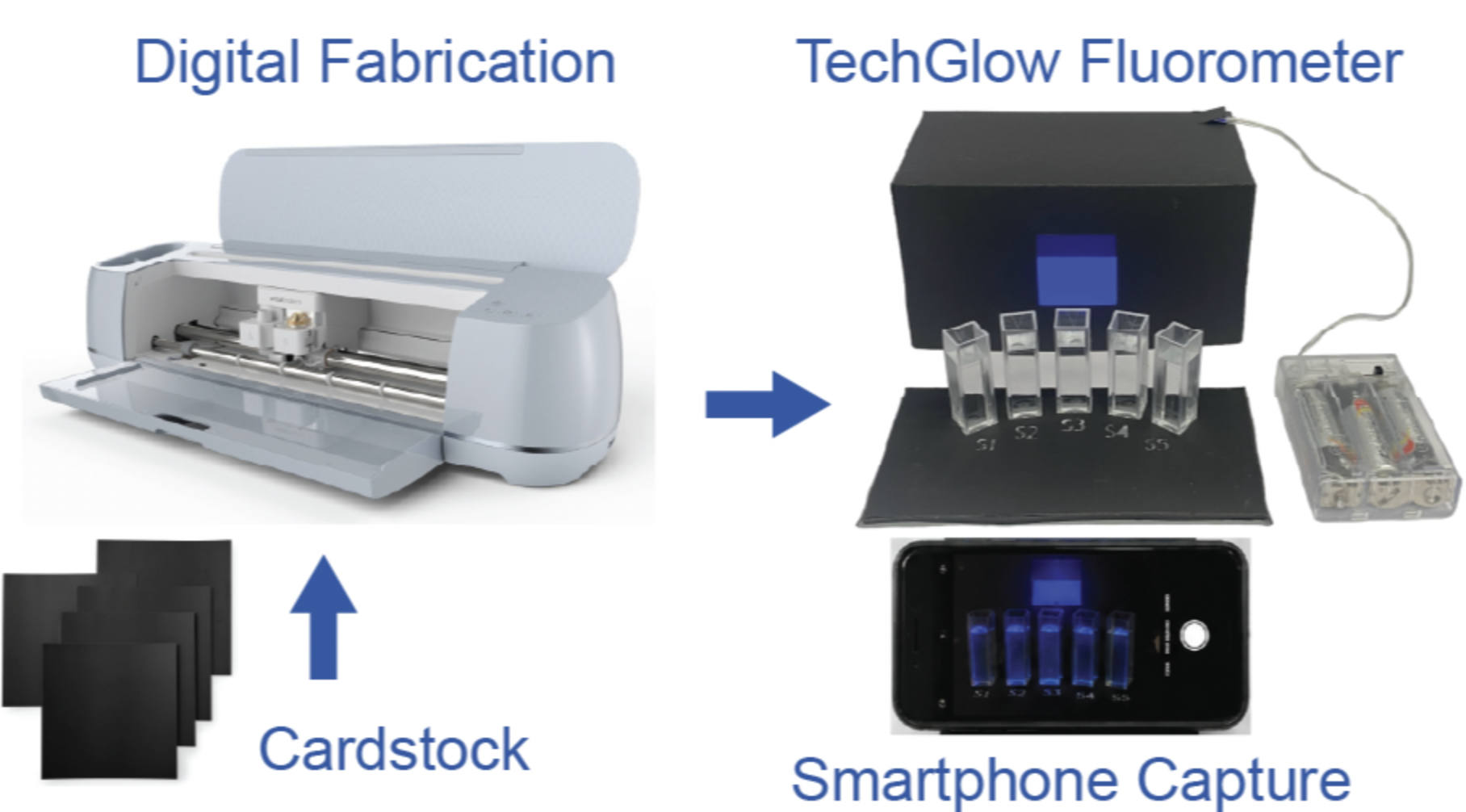
Explore, measure, discover
TechGlow supports activities ranging from a first look at fluorescence to quantitative measurements:
See fluorescence in action. Compare water, diluted tonic water, and undiluted tonic water under UV light.
Connect brightness with concentration. Prepare dilutions and investigate how the amount of quinine affects the fluorescence.
Use your smartphone to make measurements. Analyze image brightness, build a calibration graph, and determine the quinine concentration in a tonic-water sample.
The introductory activity is designed for middle-school classrooms and outreach. The quantitative activity offers additional challenges for high-school and college laboratories.
Build your own TechGlow
The cutting template and instructions are available so you can make TechGlow for your classroom, outreach event, or science project.
Cutting template
Email Dr. Smith for the SVG file shown below:
Assembly instructions and student activities
Our Journal of Chemical Education article describes the design and experiments. Its Supporting Information includes illustrated assembly instructions and two student protocols.
What you’ll need
Heavyweight black cardstock: We used 12 × 12-inch sheets approximately 0.012 inches (0.30 mm) thick. Choose cardstock compatible with your cutting machine. Example cardstock
A desktop cutting machine: We used a Cricut. The SVG template can also be adapted for other cutting machines or used as a guide for hand cutting.
A USB-powered UV LED strip: Use the strip configuration described in the assembly instructions. Example LED strip
Compatible connectors: If needed for your LED strip, use connectors that match its width and electrical contacts. Example 2-pin connectors
Clear plastic cuvettes: TechGlow holds up to five standard cuvettes for comparing samples. Example cuvettes
A compatible USB power source: A USB power bank provides a convenient portable option.
Glue or double-sided tape: For assembling the cardstock pieces and securing the light strip.
A smartphone: For photographing samples and measuring fluorescence intensity.
Follow the assembly and student protocols for safe use of the cutting tools, UV light source, and experimental materials.